⇄
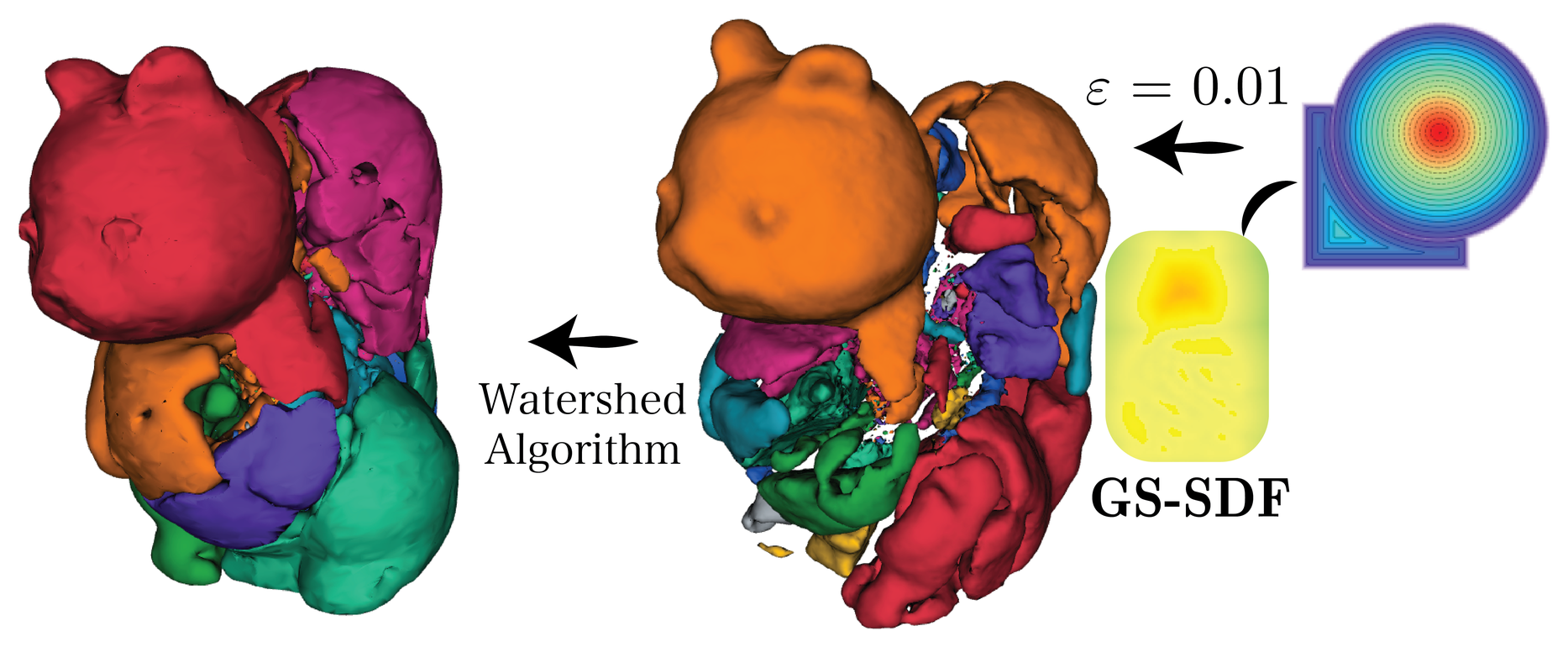
Implicit distance-field representations, such as signed and unsigned distance fields (SDFs and UDFs), have become fundamental tools for learning and modeling 3D geometry. However, when applied to segmented closed surfaces—closed solids decomposed into many labeled regions with complex internal interfaces, as in brittle fracture fragments or multi-material parts—standard UDF-based formulations become increasingly difficult to optimize when many small fragments are present, often requiring substantially longer training and making numerical convergence a poor indicator of whether small-fragment geometry has truly converged.
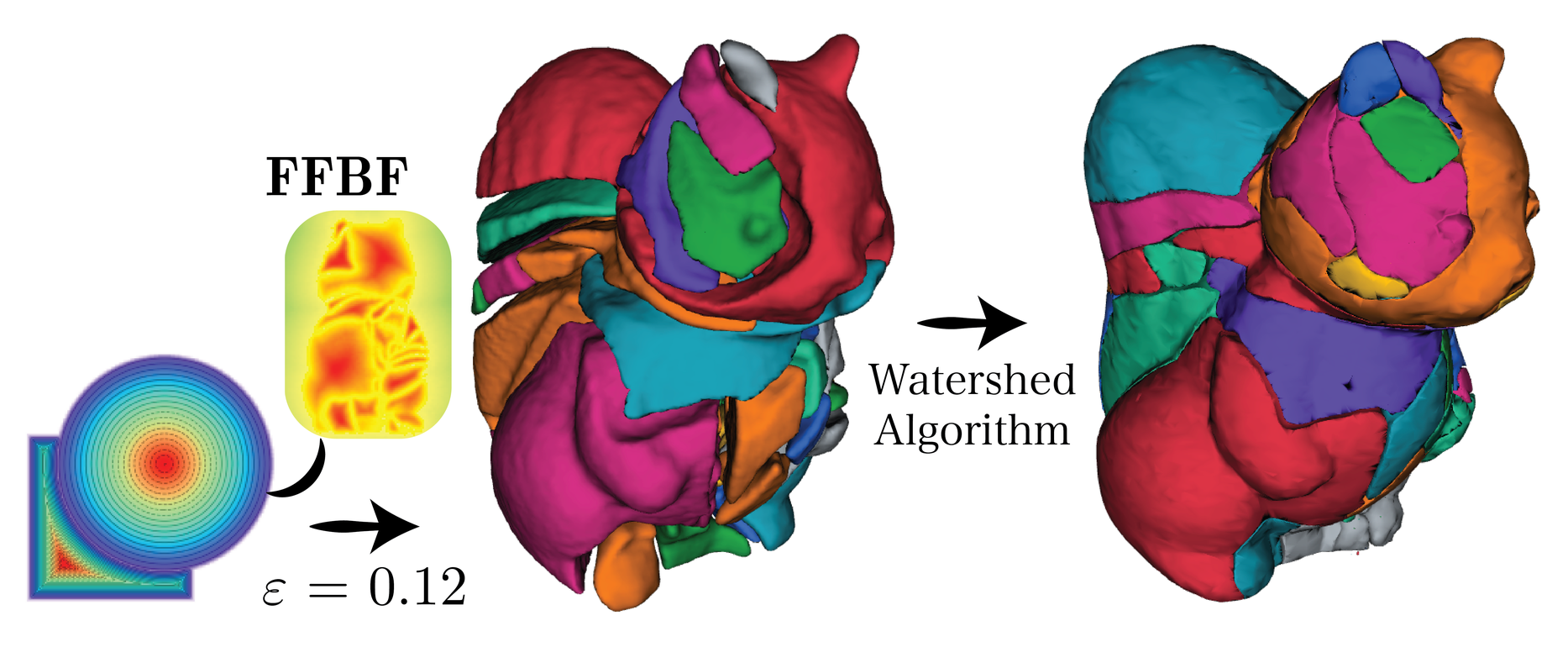
We introduce Far-From-Boundary Fields (FFBFs), a boundary-aware scalar field representation tailored to segmented solids. FFBF is obtained by per-fragment reparameterization of a segmented distance field, while preserving the zero level sets and fragment labeling of the underlying solid. This yields a more balanced and stable implicit field in which fragment-wise boundaries are easier to capture, and treats segmentation as a generative distance-field-based representation rather than a separate label prediction problem.
Across brittle fracture benchmarks, we show that FFBF consistently improves geometric accuracy, small-fragment recovery, and internal-boundary consistency compared to direct UDF baselines and common variants. These results indicate that FFBF provides a useful reparameterization for learning-based modeling of segmented volumetric structures, including applications to data-driven brittle fracture prediction.
The reference implementation, bundled sample data, and all four experiments (encoding comparison, training-trick ablation, external SOTA comparison, and activation ablation) are available in our GitHub repository. A zero-setup Colab notebook reproduces a paper figure end-to-end in minutes. This work has been awarded the Graphics Replicability Stamp (GRSI).
This work is part of our neural brittle-fracture series. The far-from-boundary encoding proposed here builds on the fracture representation used in DeepFracture: A Generative Approach for Predicting Brittle Fractures with Neural Discrete Representation Learning (Computer Graphics Forum, 2025), and the training data is produced by its BEM brittle-fracture simulation pipeline.
@article{huang2026ffb,
  author  = {Huang, Yuhang and Kanai, Takashi},
  title   = {Far-From-Boundary Fields for Learning Segmented Implicit Solids},
  journal = {Computers \& Graphics},
  volume  = {138},
  pages   = {104648},
  year    = {2026},
  doi     = {https://doi.org/10.1016/j.cag.2026.104648},
  url     = {https://www.sciencedirect.com/science/article/pii/S0097849326001196}
}